

Why Stressed People Can’t Create a Healthy Future
If we’re serious about adopting a new perspective on sustainability — about doing things differently — then an honest question follows:
Where do we start?
Often, we want to believe it should be the other. But as the logic goes, when you point a finger at someone else, three fingers point back at you (and one at God — but that’s a whole other conversation).

Source: Unsplash. Action! Johannes W. johanneswre
So here we are.
Sustainability starts with the self.
For years, the sustainability movement has focused on saving the world. A beautiful and deeply commendable intention — one I imagine most people reading this align with. And yet, if we’re honest, the results have not been as effective as we hoped.
Sending money abroad has undoubtedly created a lot of good. It has also, in some cases, created long-term dependency — showing us that good intentions alone are not always sustainable. As “the world” received most of our attention, our own communities were often neglected.
So, with time, the message shifted: help locally.
Again, many great things happened — and yet, once more, a familiar pattern emerged.
Communities benefited.
But what about the individual?
Which brings me to the next step.
And yes, it might sound confronting.
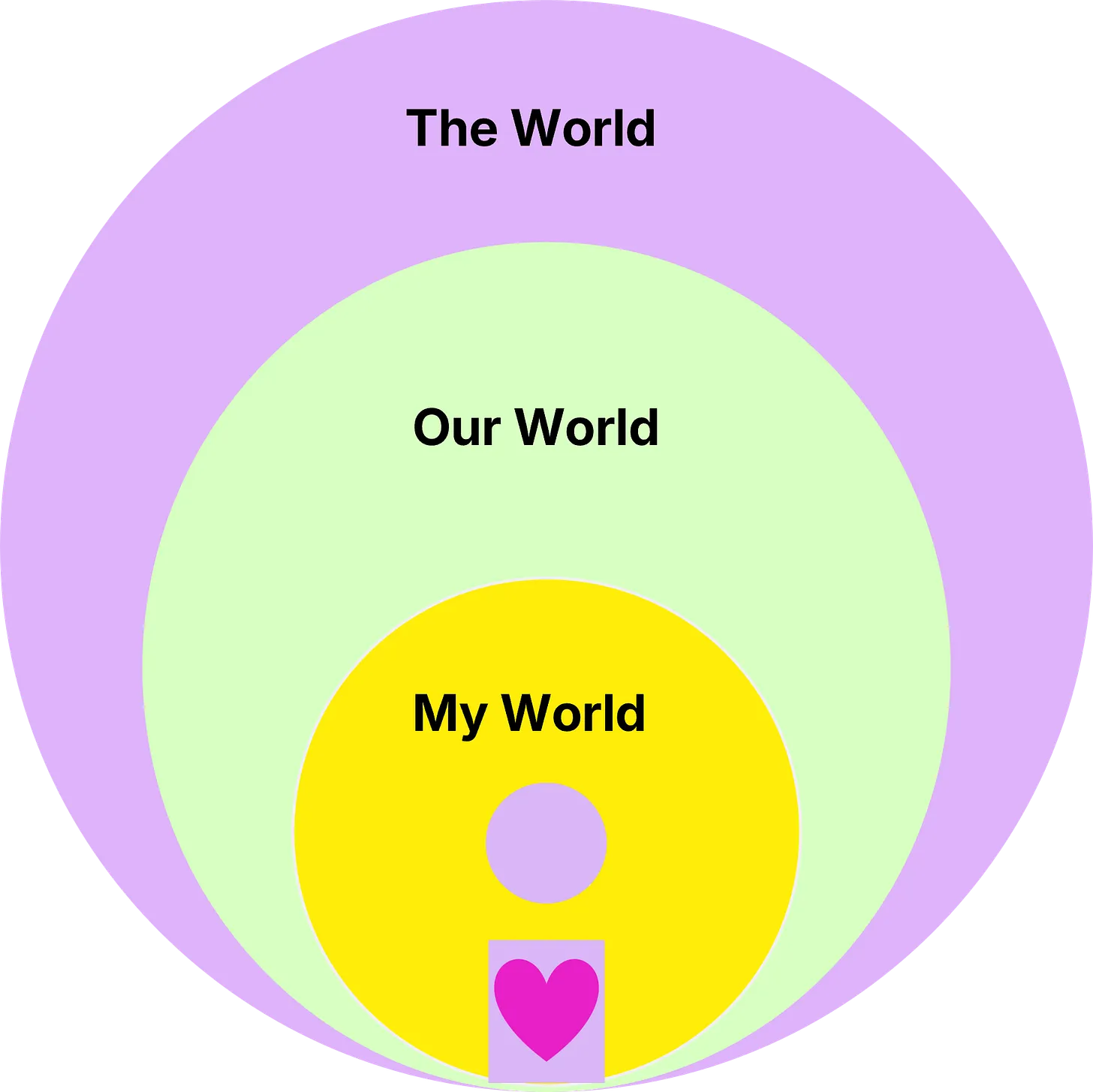
What if sustainability starts with the self?
Shocking… or maybe not.
Enter my favourite question:
Can disconnected and stressed people create a healthy future?
Spoiler alert: I don’t think they can.
Hear me out.
Every day, millions of people go to work stressed.
Stressed to perform.
Stressed because they don’t sleep well.
Stressed because they don’t actually like what they’re doing.
Stressed trying to save the world.
Stressed trying to look the part.
Collectively, the global workforce (and I’m focusing mainly on office workers here) moves through its days in glass buildings, with overbooked calendars, back-to-back meetings, and the same familiar explanation:
I have no time. I’m stressed.
With little space to pause, reflect, or reconnect — almost zombie-like — we continue in the rat race, justifying that we perform best under pressure and don’t like resting. There is immense disconnection, both from ourselves and from one another.
Have you ever heard the theory: “Shit in, shit out”?
Crude, yes.
Accurate, also yes.
If we are creating the future on overdrive — from a place of anxiety, scarcity, and exhaustion (and don’t forget the reduced fresh air in the glass box) — how can the future ever be better?
To be clear: good things happen in glass boxes, and stress isn’t always bad.
But healthy stress (and fresh air) creates healthy action.
And healthy action has rhythm, recovery, and an end.
This is only possible when consciousness begins — when an individual takes responsibility for themselves. When there is an internal inspection. An uncomfortable self-confrontation. One that begins with observing and understanding one’s ways, tasks, and contribution.
All of this can be profoundly beneficial — for the individual, the community, and the world — when it comes from calm, thoughtful reflection, rather than another stressed, last-minute attempt to “quickly fix it”.
I imagine this may not be news to many. But as we are collectively victims of our own “success”, the real question becomes: how did we get here? Especially given that our intentions were mostly good.
My theory is this: in the process of our evolution, we became part of systems and worlds so large that we lost ourselves. Literally disconnected — subconsciously, albeit. In a wave of hyper-connectivity, we became so obsessed with doing well for others that we forgot ourselves.
Forgetting that individuals — including ourselves — are the point of it all.
In my work with leadership teams and organisations, everything begins with self-awareness.
How are you perceived?
How do others experience your behaviour?
What do you stand for?
What are you actually trying to achieve?
When this is clear, real collaboration and performance become possible. Without self-awareness, we don’t truly understand how we contribute to a group — we simply exist within it. And a group without individuals is just noise.
So I promote this:
Everything starts with us.
With our presence.
With our awareness.
With our power.
And to be very clear: this is not about ego.
It’s about knowing thyself — so you can be of greater value to others.
When clear, healthy, conscious individuals come together, they can serve a shared purpose in a grounded and effective way. When many do this, a movement emerges. And movements have the power to influence the world.
So perhaps the same logic follows — with different input:
Calm in. Calm out.
When I boarded the sustainability train nearly 20 years ago, I was worried, intense, and deeply stressed. You could have called me a driven rebel — but in truth, I was running on urgency, pressure, and fear, and I was often pretty aggressive in my ways.
I was young and passionate — but that energy wasn’t effective.
It burned me out.
And it taught me the most important lesson of my life.
That our tone sets the stage.
And if we intend to create health and calm, we must act accordingly.
Is this easy? Absolutely not.
As assignments bring me back into glass boxes and threaten to consume every free space in my agenda, the struggle is real. But that’s the point. It’s an invitation to rise — everyone, everywhere — into the new reality we urgently need.
One that starts with me, and can lead to a world of healthy, fulfilled beings — thriving in energy-positive and waste-free ways of living.
Because, cheesy as it may sound, it’s true:
I am the change.
My everyday actions.
The way I enter a room.
The words I choose.
What I give my time to.
I am the beginning of the system.
My presence sets the tone.
And only I have the power to change it — to see more of what I want.
Yes, it hurt to learn this.
Yes, I had to slow down.
But not forever.
Because once grounded, clear, and connected, a new way of thinking becomes possible — and that way of thinking accelerates when it isn’t driven by fear, guilt, or pressure, but by purpose and gusto.
Confrontational? Yes.
Easy? No.
Possible? Absolutely.
—
By Stephanie Bartscht
Founder of EVERiSE
Sustainability starts within.
I work with brave leaders and leadership teams who can feel the future knocking and want to answer with clarity, connection, and confidence. Through EVERiSE, I help organisations navigate complexity from the inside out — so sustainability becomes something people can actually live.