

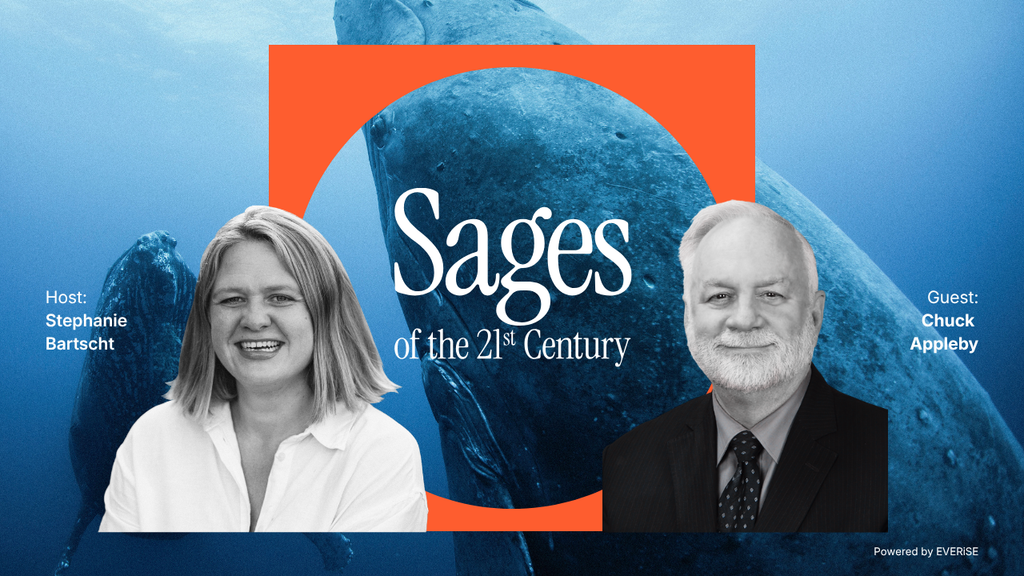
A conversation with Chuck Appleby
Sages of the 21st Century – S1.E2
What does it take to lead when you don’t have the answers, and shouldn’t pretend to?
A Note from Stephanie
Chuck is one of those people you meet whose presence immediately warms and reassures your soul. Filled with kindness and care, he loves people and has dedicated his 45+ long career to exploring what they need to be their best and succeed together in teams.
With the brain of an engineer and the curiosity of a kid, Chuck has been working in organisational change since what feels like the beginning of its existence… and what’s clear is that the tricks of the trade haven’t changed much… because they don’t need to. Being human has always been the same, and talking with Chuck always reminds me of that timeless wisdom.
This conversation is an easy listen, after which you are guaranteed to be better able to navigate change and facilitate systemic evolution. (Something I think we can all agree that more people and leaders need to be able to do). Chuck is humble, but do not mistake this. He has helped some of the world’s most important organisations evolve, sometimes at a high personal cost.
Talking with Chuck reassured me that this Podcast series can be of great value to the right people. So many organisations right now are trying to find the right way to change and design the optimal setup for the future. What Chuck reminds us of is that the answers come through dialogue and daring to speak up. There may never be a perfect, optimal solution, but that’s not the point either. The point is to be on the journey together, reflect, learn, and be ok with navigating the unknown, failing and maintaining courage and integrity to do the right thing along the way.
Meet Dr Chuck Appleby
Dr Chuck Appleby holds a doctorate in international relations and has spent his career as an organisational development consultant, helping leaders and change agents envision, design, build and sustain high-performing cultures. His path has been anything but linear: it began aboard a nuclear submarine, where he served as a history major turned nuclear engineer, and went on to include advising U.S. government officials and working with organisations as varied as the CIA, the World Bank, Salesforce, the Veterans Health Administration and the nuclear waste site at Hanford.
Long before “agile” and “psychological safety” became corporate buzzwords, Chuck was in the field helping leaders slow down, ask better questions and transform their cultures from the inside out. A self-described generalist with an intense, lifelong curiosity, he draws on Action Reflection Learning (ARL), powerful questioning and peer coaching to help organisations discover their own answers rather than wait for a guru to hand them one. At 74, he has come to embrace the word “sage”, not as an expert with all the answers, but as someone who has been around a while and wants to share what he knows.
What We Explore in This Episode
This conversation moves between big-picture ideas and hard-won stories from the field. Among the threads Stephanie and Chuck follow:
The shift from a culture of knowing to a culture of asking, and why the real job of a leadership and organisational development coach is to build agency and self-awareness, not to supply solutions.
Trust as the foundation of change, drawn from a live example of a CEO caught in a genuine dilemma: his team wanted him to give more direction, yet distrusted him when he did.
Leading in the unknown, and how curiosity and a generalist’s breadth of knowledge become assets rather than liabilities in a VUCA world.
Action Reflection Learning, the practice of never accepting a problem as first presented, and taking time to reframe it, plus why there is no sustained, deep learning without reflection.
Dilemmas and polarities, tensions like revenue versus profit, or direction versus input, that can’t be “fixed” but must be navigated over time, illustrated through the Veterans Health Administration and the Confucian idea of finding the harmony point.
Powerful questions and deep listening, including the single question that reframed one of Chuck’s own challenges, and the discipline of listening for what isn’t being said.
Adaptability as the defining quality of resilient cultures, and the three drivers of motivation: mastery, autonomy and pride, that help people and organisations grow.
The courage it takes to tell leaders a difficult truth, and the real personal cost that sometimes comes with doing the right thing.
A Few Lines That Stayed With Us
“You don’t change an organisation by changing its rules. You change it by changing how people listen, learn and grow together.”
“You (should) never accept the problem as presented. You must always spend some time framing, clarifying the problem.”
On the most powerful question he was ever asked: “What haven’t you told me that I need to know so that I can help you?”
“You don’t fix a dilemma. It never goes away.”
“It’s not the strongest, or the smartest. It’s the most adaptable that survive.”
Listen
You can listen to this episode on Substack and across all major podcast platforms. Search for Sages of the 21st Century wherever you get your podcasts, and follow the show to catch future episodes.
Episode References
A few of the people, books and ideas mentioned in this conversation:
Find Chuck Appleby on LinkedIn:
https://www.linkedin.com/in/chuck-appleby-8391742/
Michael Bungay Stanier’s books The Coaching Habit and The Advice Trap – https://www.mbs.works/books/
David Epstein’s book Range: Why Generalists Triumph in a Specialised World (referenced in the episode as “The Generalist”) https://davidepstein.com/range/
Daniel Pink’s book Drive, and the three motivators of mastery, autonomy and purpose (discussed here as mastery, autonomy and pride) https://www.danpink.com/books/drive/
Reg Revans: the physicist who developed Action Learning at Cambridge https://www.actionlearningassociates.co.uk/action-learning/reg-revans/
Ernie Turner and Isabel Rimanoczy’s book Action Reflection Learning (Isabel is a future guest on the show) https://www.limglobal.net/lim-books
Brené Brown: on vulnerability and leadership – https://www.youtube.com/watch?v=iCvmsMzlF7o
VUCA: the volatile, uncertain, complex and ambiguous world.
The concept of polarities/dilemmas, and the Confucian idea of yin and yang and the “harmony point”.
The “elephant sculpture” exercise for opening up analytical thinkers.
Production by Alexandra Normand. Sound editing by Robbie Redway. Artwork by Koen Hogewoning. Hosted by Stephanie Bartscht, founder of EVERiSE.