

A conversation with Eugenio Moliní
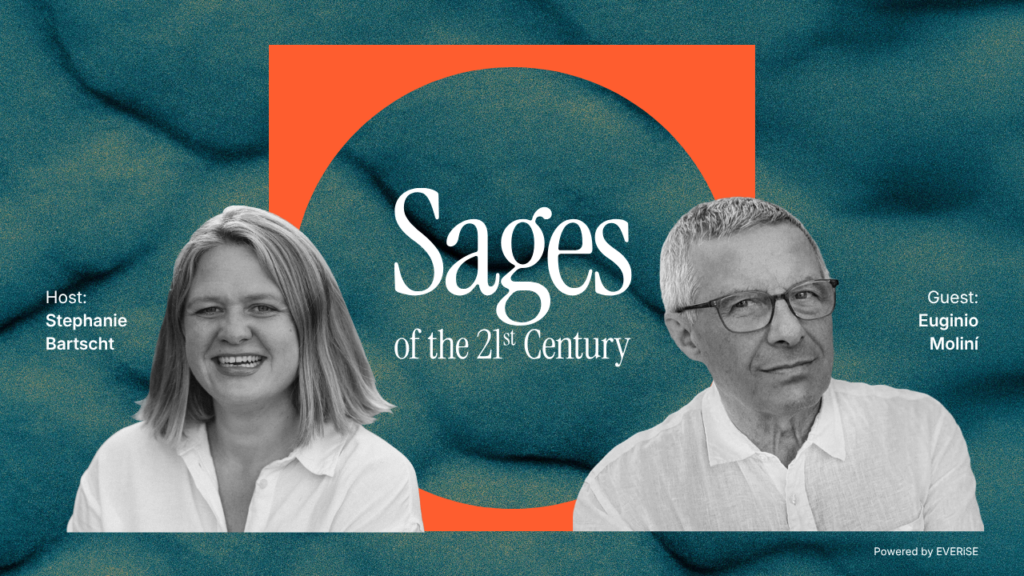
Sages of the 21st Century – S1.E1
What happens when a change consultant chooses authenticity over commerciality?
A Note from Stephanie
This conversation is rich, potentially provocative yet deeply reassuring.
Eugenio has that effect… ever since I met him.
Authentic, real, and far from conventional, Eugenio is a kind, peaceful, and wise Sage sharing his knowledge, energy, and human perspective after more than 4 decades as an international Change consultant.
This is a deeply human conversation. Eugenio is honest. The message is different. Which I find inspiring. Because for me it’s the right different.
That return to human authenticity kind of different.
In this conversation, I was again reminded that we humans have and are the solution to our shared world’s entangled complexities. That everything starts either with the self, the other or the whole. And as Eugenio says, it doesn’t matter where you start; eventually you will meet them all.
Thank you to Eugenio for this expansive conversation.
If you’re curious about change, in particular in organisations and teams, I invite you to take 65 minutes… Press play and open your head, heart and mind as you journey into the perspectives of this very special Sage.
About Eugenio Moliní
Eugenio Moliní is a Gestalt practitioner and facilitator, and one of the quietly radical voices in organisational change. Originally from Spain and now based in Sweden, he has been designing and facilitating change processes since 1989, working inside boardrooms, joint ventures, and cultures far outside the reach of conventional consulting.
Eugenio consciously chose to never become a “mainstream” consultant: he wasn’t prepared to negotiate his authenticity. After being asked again and again to know the outcome of his work before starting, he realised… he can’t and won’t do this work in the conventional way. Eugenio doesn’t work that way. He works from presence rather than prescription, asking the questions that let people, teams, and organisations find their own next step whilst being there with them.
Along the way, he’s walked away from the things most consultants spend a career building: a training institute, a certification system, a legacy. Not out of bitterness, but out of a hard-won understanding that anything built to last eventually becomes a straitjacket for him, so he gives his methods away freely and never seeks credit.
Eugenio has trained Gestalt practitioners for four decades and considers himself, above all, a fellow explorer of what he calls “the mystery”, the boundary between what we know and what we don’t.
What We Explore in This Episode: Change, Gestalt, and Letting Go
This conversation moves slowly and honestly through four decades of Eugenio’s thinking on change, presence, and what it actually means to be of service.
Stephanie and Eugenio explore:
Why Eugenio never became a mainstream consultant, and how he built a practice by working through “boundary spanners”, the people with one foot inside the system and one foot out, who took a risk to bring him in.
The double bind he deliberately creates with clients, where whatever they choose, they succeed. Why part of his fee is simply being available to take the blame, even when it isn’t his fault, and how he stays loyal both to the assignment and to the person who hired him.
Gestalt, explained in three parts: a philosophy of living at the edge of what we don’t know, a personal practice of training yourself to stay there, and a professional practice of helping others do the same.
Phenomenology and radical self-acceptance: why you cannot change what you don’t first accept, and why so many organisational “values” exercises fail because they describe who a company wants to be without ever naming who it actually is.
Why the present matters more than the past or the future, and the deep personal and professional crisis in 2012 that finally taught Eugenio to live this, rather than simply teach it.
“I don’t build things that last”, the training institute he walked away from, the certification system he refused to create, and why lasting things eventually become a straitjacket.
The three questions Eugenio asks any team stuck in a decision: how does this affect me, how does it affect others, how does it affect the whole, and the story of a stalled joint venture in China they finally unstuck by asking them.
What Eugenio believes his actual job is: not providing solutions, but staying with people at the exact point where their frustration and excitement meet, until they can see clearly enough to move themselves.
What he thinks business needs more of right now, in one word: stop.
A Few Lines That Stayed With Us
“The moment I am part of something, it stops being a system to me, and I don’t know how I can change anything I’m not part of.”
“There’s a special kind of double bind where whatever you do, you succeed. You choose where you put the frustration, but the frustration will always be there.”
“How can I take care of myself regarding both love and pain. How do I take care of others regarding both love and pain. And how can I take care of the whole regarding both love and pain […] It doesn’t matter where you begin”.
“No company needs to grow so much. There’s room for everybody. You don’t need to be a pirate.”
“Everybody is a sage.”
Listen to the Episode
Listen on Substack
Listen on Spotify
Listen on Apple Podcasts
Listen on YouTube
Episode References
Eugenio Moliní on LinkedIn
https://www.linkedin.com/in/eugeniomolini/
Gestalt Akademin i Skandinavien: Eugenio is core faculty here, teaching Gestalt approaches to organisational development alongside practitioners from around the world. https://www.gestaltakademin.se/resilientorganizations
Gestalt Institute of Cleveland, “What is Gestalt?”: the clearest practitioner-written introduction to the philosophy and practice Eugenio draws his entire approach from; discussed in depth around the 21-minute mark. https://www.gestaltcleveland.org/what-is-gestalt
“Phenomenology”: the philosophical root of Eugenio’s “you cannot change what you don’t accept” principle; discussed around the 27-minute mark. https://gestaltreview.com/phenomenology-and-gestalt-therapy/
Gregory Bateson’s double bind theory: the concept behind Eugenio’s favourite client intervention, first developed in his 1972 essay collection Steps to an Ecology of Mind; discussed around the 14-minute mark. Primary source: https://press.uchicago.edu/ucp/books/book/chicago/S/bo3620295.html — Accessible explainer: https://www.psychologytoday.com/us/blog/escaping-our-mental-traps/202402/speak-your-mind-but-not-like-that-the-double-bind-theory
Shunryu Suzuki, Zen Mind, Beginner’s Mind — referenced by Eugenio as a tradition with deep parallels to Gestalt’s way of sitting with the unknown; mentioned around the 26-minute mark. https://www.shambhala.com/zen-mind-beginner-s-mind-1796.html
Production by Alexandra Normand. Sound editing by Robbie Redway. Artwork by Koen Hogewoning. Hosted by Stephanie Bartscht, founder of EVERiSE.